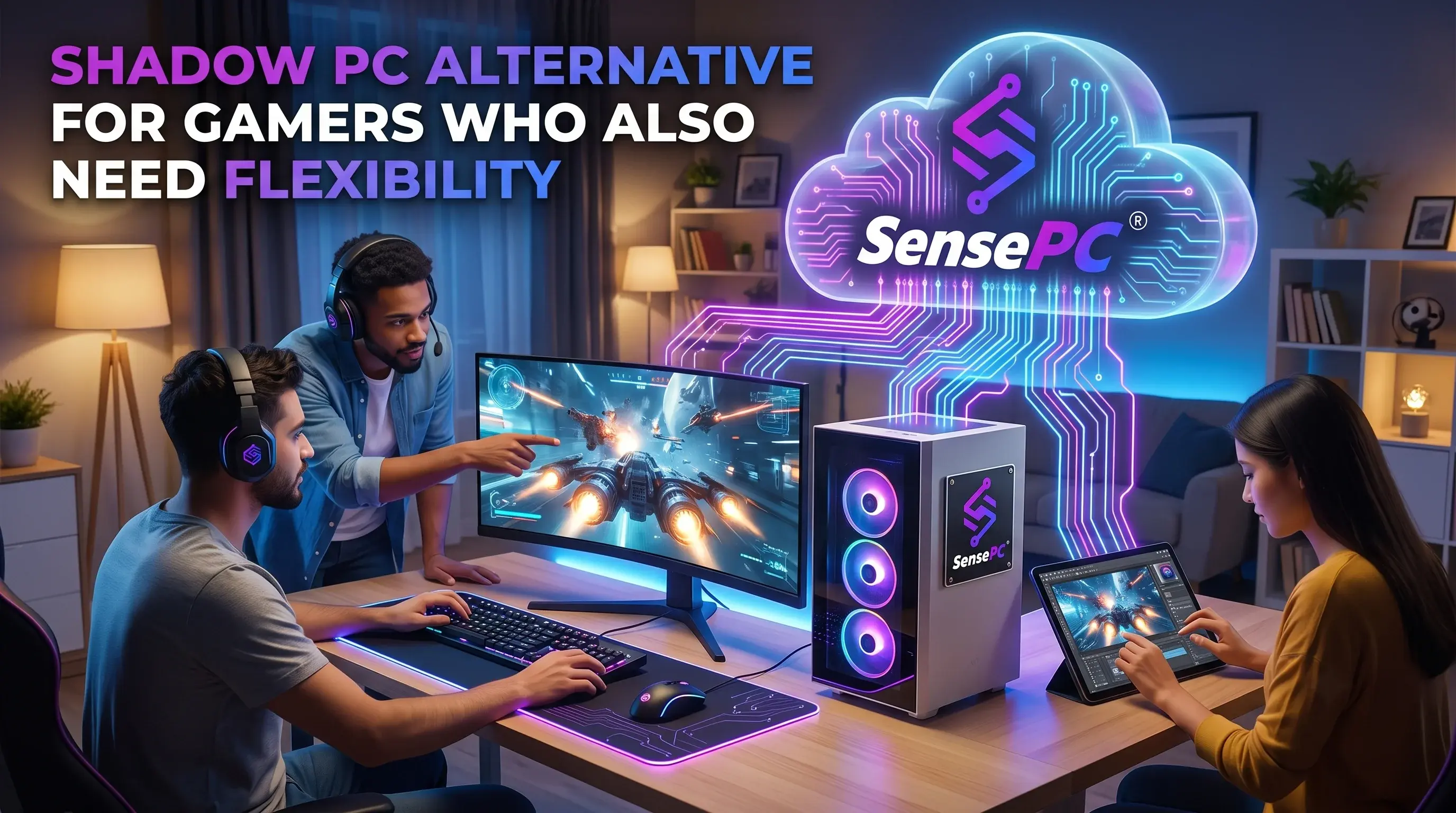
Quick answer: If you're comparing Shadow PC alternatives because the monthly cost keeps running whether you use it or not, SensePC is worth a look — not as a gaming-first replacement, but as a flexible, pay-as-you-go cloud PC that handles gaming well alongside everything else you might use it for. If your primary need is dedicated, always-on gaming performance, Shadow PC's fixed gaming-tier hardware may still be the better fit.
You notice the limits fast when a cloud PC looks good on paper but feels wrong in practice. Maybe the monthly price keeps running even when you barely log in. Maybe storage feels tight once you install a few modern games. Maybe you only play on weekends, but you're paying for a full month regardless. If you're searching for a Shadow PC alternative, the real issue usually isn't access to a cloud PC — it's a billing model and setup that doesn't match how you actually use one.
What to Compare Before You Switch From Shadow PC
Before picking a Shadow PC alternative, it helps to separate the two decisions that actually matter: what you'll use the machine for, and how you'll be billed for it.
Billing that matches actual use. A flat monthly plan makes sense if you use a cloud PC every day as your primary machine. It makes a lot less sense if you play heavily some weeks and barely touch it the next. Hourly and pay-as-you-go pricing exists specifically for that second pattern — you pay for the sessions you actually run, not for a month of access you didn't use.
Storage that stays with you. Persistent SSD storage matters more than it sounds like on a pricing page. Modern games can run 80–150 GB each, and without persistent storage, every session starts with reinstalling something. A cloud PC that wipes or limits storage between sessions creates ongoing friction that a spec sheet doesn't show.
What you're actually using it for. This is the part most comparisons skip. A cloud PC used purely for AAA gaming has different priorities — frame consistency, input latency, dedicated GPU tier — than a cloud PC used for a mix of gaming, remote work, and creative software. If your use case is the second one, a provider built around flexibility, not a fixed gaming rig, is often the better fit.
Where SensePC Fits
SensePC isn't positioned as a gaming-first cloud PC the way Shadow PC is — and it's worth being upfront about that instead of overselling it. Shadow PC's own strength is a dedicated, high-performance GPU tier built specifically for committed gamers who run their desktop daily.
SensePC's strength is different: configurable specs, pay-as-you-go billing with idle auto-shutdown, built-in cloud storage without a separate subscription, and fast provisioning — generally in the 2–4 minute range. That combination tends to suit a specific kind of user well:
Occasional or weekend gamers who don't want to pay a full month's subscription for a handful of play sessions
Remote workers and students who want one cloud PC that handles both productivity software and gaming, rather than paying for two separate services
Teams or small businesses that need multi-user management and admin billing controls alongside the ability to run graphics-intensive workloads, including games
If your priority is squeezing the maximum possible frame rate and latency out of a dedicated gaming rig you'll use every single day, a purpose-built gaming service — Shadow PC included — is likely to outperform a flexibility-first cloud PC. If your priority is not overpaying for a machine you use inconsistently, or you need one cloud PC that covers both gaming and other work, that's where SensePC's model has a real advantage.
Shadow PC vs. SensePC: Quick Comparison
Shadow PC | SensePC | |
Primary focus | Dedicated gaming performance | Flexible cloud PC (gaming + work) |
Billing | Fixed monthly subscription | Pay-as-you-go, hourly to monthly |
Idle cost | Charged regardless of use | Idle auto-shutdown reduces cost |
Storage | Included in gaming tier | Persistent cloud storage included |
Team/admin features | Not offered (single-user) | Multi-user management, admin dashboard |
Best fit | Daily, committed gamers | Occasional gamers, remote workers, teams |
Who Should Actually Consider SensePC as a Shadow PC Alternative
Not everyone comparing Shadow PC alternatives has the same problem. A few patterns worth recognizing in yourself:
You play in bursts, not daily. If a new release pulls you in for a weekend and then you don't touch a cloud PC for two weeks, a flat monthly fee is working against you. Pay-as-you-go billing is built for exactly this pattern.
You're on a MacBook or non-gaming laptop and need more than gaming. If gaming is one use among several — schoolwork, creative software, remote access to a heavier setup — a cloud PC built around flexibility covers more of your actual needs than one built purely around gaming.
You're budget-conscious and want to avoid paying for idle time. Idle auto-shutdown and hourly billing specifically target the cost problem that makes flat subscriptions feel wasteful for lighter or inconsistent use.
If instead you know you want a dedicated, daily gaming machine and you're going to use it constantly, a gaming-first service with fixed high-performance hardware — including Shadow PC itself — may still be the more straightforward choice, and it's worth being honest about that rather than positioning every alternative as a universal upgrade.