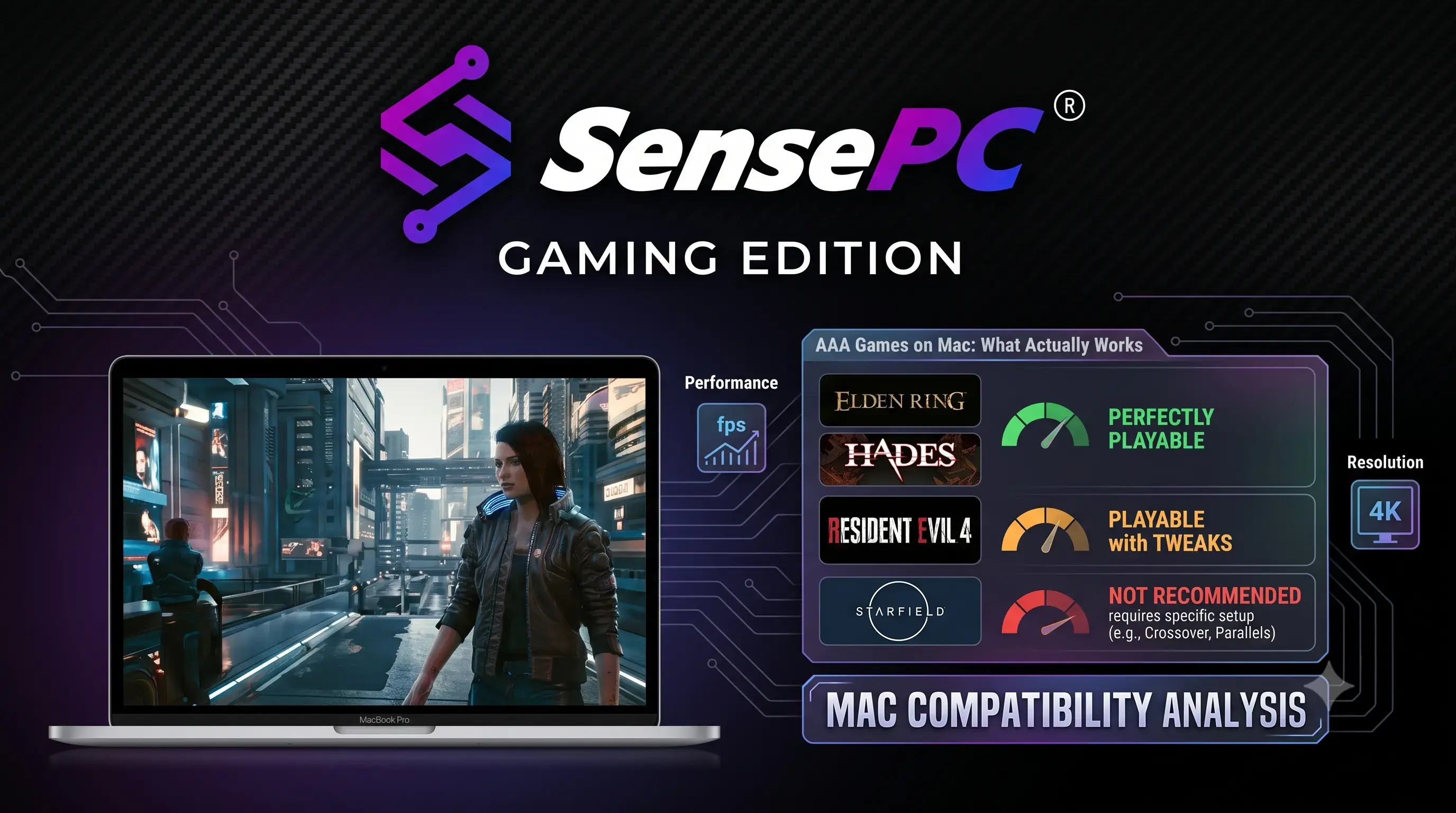
Mac users know the pattern. A big new release drops, the Steam page goes live, and then you check the system requirements only to find Windows front and center while macOS is missing entirely. That is the reality of AAA games on Mac - not a total dead end, but still a platform with clear limits.
The good news is that Mac gaming is no longer stuck where it was five years ago. Apple silicon is fast, displays are excellent, and a handful of major titles now arrive on macOS with respectable performance. The bad news is that compatibility is still inconsistent, support can disappear between releases, and buying a Mac still does not guarantee access to the latest PC blockbuster.
The real state of AAA games on Mac
If you want the short version, here it is: some AAA games run well on Mac, many do not, and the biggest issue is not always raw hardware. It is software support.
Modern MacBooks and desktops have enough CPU and GPU power for serious gaming workloads, especially on Apple silicon. The problem is that most major publishers still prioritize Windows first. That means many flagship games never get a native macOS version, and when they do, launch timing can lag behind the PC release. In some cases, updates land later. In others, they stop entirely.
That makes Mac gaming a strange mix of premium hardware and limited access. You may have a fast machine, plenty of memory, and a sharp display, but your game library still depends on whether a developer chose to support macOS in the first place.
Why AAA games on Mac still lag behind Windows
The answer is market share, engine support, and incentives.
Windows remains the default target for PC gaming because that is where the audience is. Studios build for the largest install base first, and most gaming-specific features, driver optimizations, and testing pipelines still revolve around Windows. That creates a cycle where more games launch on Windows, more gamers stay on Windows, and publishers keep prioritizing it.
Apple has improved the technical side. Metal is stronger than it used to be, Apple silicon has changed performance expectations, and game porting tools have lowered some barriers. Even so, porting is still work. Studios have to allocate engineers, QA time, and post-launch support. If they do not see enough Mac revenue, that work moves down the list.
There is also the issue of compatibility fragmentation. Intel Macs, Apple silicon Macs, Rosetta translation, native ARM builds, and changing OS requirements all affect what runs and how well. For players, that means more checking, more guessing, and more trial and error than on a typical Windows gaming PC.
What runs natively and what that really means
A native Mac game is the cleanest option. You install it, launch it on macOS, and play without a workaround. When a title is optimized for Apple silicon, the experience can be surprisingly good, especially at sensible settings.
But native support does not automatically mean top-tier performance across every Mac. A MacBook Air is not the same as a MacBook Pro with a higher-end chip, and neither behaves like a desktop setup with better thermal headroom. Some games are playable at medium settings and lower resolutions, while others need aggressive compromises to stay smooth.
The bigger issue is library size. You can absolutely find native AAA titles on Mac, but you cannot assume the next game on your wishlist will be one of them. For players who stick to a few supported franchises, that may be enough. For players who want broad access to new releases, it usually is not.
The common workarounds, and where they break down
Mac gamers usually try one of three routes when a game is not available natively: compatibility layers, virtualization, or streaming.
Compatibility tools can sometimes run Windows games on macOS without installing Windows directly. They have improved, and for older or moderately demanding games they can be useful. The trade-off is inconsistency. One title works after a few tweaks, another crashes on launch, and anti-cheat can shut the door completely.
Virtualization sounds cleaner on paper because it gives you a Windows environment, but it is rarely the best answer for demanding AAA games. Performance overhead matters, GPU access is limited compared to a real gaming machine, and many modern titles simply push past what that setup can deliver.
Streaming is the most practical option when the goal is access, not tinkering. Instead of forcing your Mac to behave like a gaming PC, you connect to actual gaming hardware remotely and run the game there. Your Mac becomes the display and control device. The performance ceiling depends more on the cloud machine and your connection than on local Mac graphics power.
When cloud gaming makes more sense than forcing local play
This is where the Mac conversation gets more practical. If your goal is to play more AAA titles instead of spending hours troubleshooting, cloud gaming solves the main problem directly: game availability on macOS.
A cloud Windows gaming PC gives you access to the platform most AAA developers actually support. That means native Windows game installs, standard launchers, and far fewer compatibility surprises. No waiting for a Mac port. No hoping a translation layer works after the next patch. No buying an external GPU setup that still leaves you stuck on the wrong operating system.
For Mac users, that changes the decision. You no longer need to ask whether your specific machine can brute-force a modern title locally. You need to ask whether your internet connection is stable enough for low-latency play and whether the service gives you enough GPU, CPU, and storage for the games you actually want to run.
That is why the cloud model fits this audience so well. No expensive gaming rig. No upgrade cycle. No hardware waiting game.
What to look for if you want to play AAA games on Mac through the cloud
Not all cloud gaming setups are built for the same use case. Some are closer to subscription streaming libraries with fixed game catalogs. Others give you a full Windows gaming desktop where you install your own games and manage your own launchers. If you want flexibility, the second model is stronger.
Performance starts with the hardware behind the session. Dedicated GPU access matters. So does SSD storage, because large modern games are brutal on load times and install size. CPU and RAM still count too, especially for open-world games, shooters, and heavily modded titles.
Latency is the next filter. A Mac connected to a weak cloud stack will still feel weak. You want a service designed for gaming, with low-latency display protocols and fast provisioning. If setup takes forever or input response feels soft, the specs on paper stop mattering.
Billing also matters more than people think. A lot of Mac users do not need a full-time gaming PC every day of the month. They want to play when they want, scale up when needed, and avoid paying for idle hardware. That is where usage-based access can beat the cost of owning a local gaming machine that ages out over time.
A gaming-first cloud desktop like SensePC fits that use case well because it gives Mac users a real Windows 11 gaming environment with dedicated GPU power, persistent storage, and quick setup instead of a stripped-down remote session.
Should you buy a Mac for AAA gaming?
If AAA gaming is your top priority, a Mac still should not be your first choice as a local-only machine. That is just the honest answer. Windows offers the widest support, the fewest compatibility issues, and the most predictable experience for new releases.
But that does not mean Mac users are locked out. If you already use a Mac for work, school, or daily life, adding access to cloud gaming is often the smarter move than buying a second high-end system just for occasional play. You keep the machine you like, avoid a large hardware purchase, and gain access to the Windows game ecosystem when you need it.
That is the key distinction. Macs are better at gaming than they used to be, but they are still not the default home for AAA releases. If you want broad access with less friction, stop trying to turn macOS into something publishers did not build for. Use the Mac you have, and get gaming power from where it is actually available.