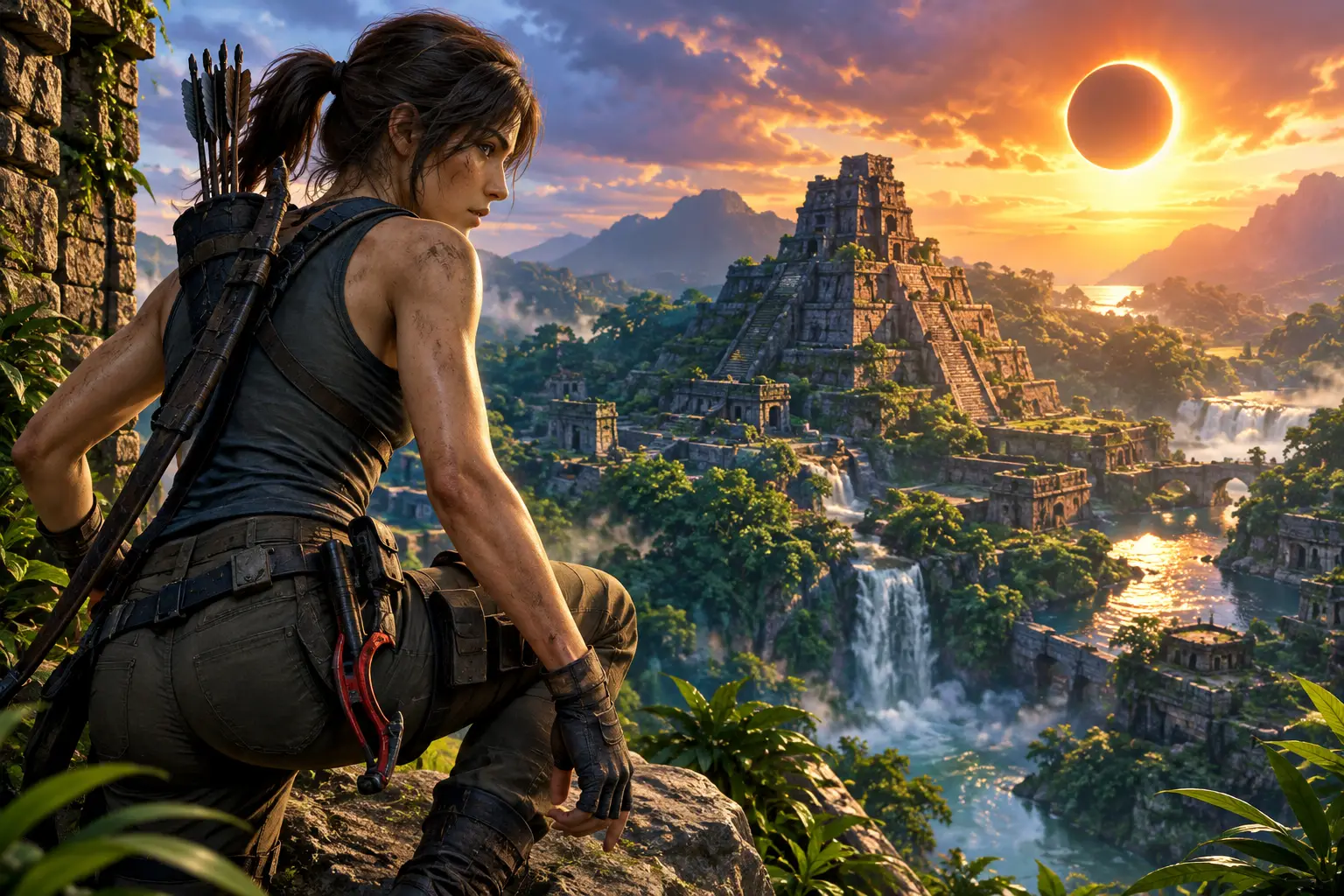
Quick verdict: Shadow of the Tomb Raider (2018) is a good-to-great action-adventure game if you like exploration, environmental puzzles and stealth. Its optional challenge tombs are the best part. The main story is uneven and open combat is its weakest area. Most players finish the story in roughly 12–14 hours, and the Definitive Edition bundles the DLC.
A mud-covered wall, a flooded tomb, and a patrol that can spot Lara through a bad approach: that is the real rhythm of this game. This review looks at one question: does the final chapter of Lara Croft's origin trilogy deliver a satisfying adventure, or does its ambition get in its own way?
It delivers more often than it misses. Shadow of the Tomb Raider is at its best when it lets you move slowly, read the environment, and choose how Lara enters danger. It is less convincing when the main story rushes past its strongest ideas.
Shadow of the Tomb Raider quick facts
| Developer / publisher | Eidos-Montréal (with Crystal Dynamics) / Square Enix |
| Series position | Final game of the reboot "Survivor" trilogy, after Tomb Raider (2013) and Rise of the Tomb Raider (2015) |
| Release date | September 14, 2018: PlayStation 4, Xbox One, PC |
| Later ports | macOS, Linux and Stadia versions in November 2019 (Stadia has since shut down) |
| Main-story length | About 12.5–14 hours (reported) |
| 100% completion | About 39–42.5 hours (reported) |
| Critic score | Metacritic Metascore about 75, "generally favorable" (reported; varies by platform) |
| Co-op | Limited to DLC challenge tombs (reported; verify) |
| Best edition for new players | Definitive Edition (base game plus the DLC) |
Figures marked "reported" come from aggregators and AI-search answers. Check them before relying on them.
What Shadow of the Tomb Raider's gameplay changes
The biggest difference is confidence in the jungle setting. Earlier games often pushed Lara through spectacular set pieces. Shadow still has collapse sequences and firefights, but it gives more weight to preparation. You gather materials, improve equipment, scout routes, and use dense terrain to control an encounter.
The jungle is not just scenery. Vines hide traversal paths. Mud lets Lara blend into certain walls. Trees create vertical routes above enemy patrols. Water can cover a quiet approach or force you to find air pockets. When these systems work together, the game creates tension without requiring constant combat.
Is Shadow of the Tomb Raider a stealth game?
Partly, and stealth is its standout system. Lara can distract enemies, hide in vegetation, hang from branches, and use mud-covered surfaces to stay out of sight. A careful player can thin a group before anyone knows what happened. A more direct player can still use bows, firearms and crafted explosives, but open combat is usually more demanding than it needs to be.
That tradeoff is deliberate. The game rewards patience, but it does not always explain every option clearly. Some encounters feel designed for stealth until an enemy path or detection moment breaks the plan. If you enjoy adapting, that unpredictability can be exciting. If you want consistently precise stealth rules, expect a few frustrating resets.
Is it a survival game?
Only lightly. To survive the jungle, you do not need to manage hunger, sleep or a deep crafting economy. This is an action-adventure game, not a survival simulator. The survival element comes from reading hazards and using the landscape well.
Materials found around the world support ammunition, healing items and upgrades. Hunting can help with resources, though it is not a complex system. The more meaningful challenge is noticing what the environment is telling you: a climbable ledge, a weak barrier, a submerged passage, or a concealed route around a hostile camp.
Players who rush straight toward the objective marker will miss much of what makes the game work. Look upward before moving forward, and check side paths near rivers and cliffs.
Challenge tombs: the best reason to play
Shadow of the Tomb Raider understands that Lara Croft should spend time in tombs. Optional challenge tombs are larger, more mechanical, and usually more rewarding than those in the previous two games. They use water flow, counterweights, fire, wind and rotating mechanisms to create satisfying spatial puzzles. Tracked sources report 9 challenge tombs in the base game and 7 more in the DLC, each rewarding Lara with a skill or ability (verify the counts before publishing).
These spaces are also where the visual design shines. The game moves from rain-soaked jungle to underground ruins, mountain settlements and elaborate ritual structures. You are gradually learning how a culture, its myths and its architecture fit together.
Puzzles are rarely impossible, but they are more engaging than simple switch hunts. If you get stuck, identify what the machine is meant to move, fill, burn or block. The answer is usually in front of you.
Exploration has one weakness: the map can be overloaded with collectibles. Documents and relics add context, but the volume can turn discovery into cleanup. Completion-focused players may enjoy the density. Players who want momentum should prioritize tombs, crypts and story-relevant side content.
Can Lara really stop the apocalypse? The story
The story begins with Lara taking an artifact that triggers a catastrophic chain of events. Her mission is to recover it before a Mayan apocalypse devastates the world. It is a strong premise because it forces Lara to face the consequences of her own choices rather than simply react to someone else's threat.
The problem is pacing. The game raises difficult questions about obsession, cultural theft and the cost of pursuing a goal at any price, then sometimes moves through them too quickly to give them full weight. The villainous organization is familiar, and several major turns feel less developed than the setting deserves.
Lara herself is compelling, especially when the story lets her be stubborn, frightened and wrong. She is more interesting when the game acknowledges that determination can become recklessness. The local community at the center of the story brings needed perspective, but the writing does not always use those characters as fully as it could.
Do you need to play the earlier games first? It helps but is not required. Shadow recaps enough of Lara's arc to follow, but the emotional payoff of "final chapter" is stronger if you have played Tomb Raider (2013) and Rise of the Tomb Raider.
How do critics and players rate Shadow of the Tomb Raider?
Reception was generally favorable. Critics most often praised the visuals, the tombs and the sense of place, and were more mixed on the story and combat. The tracked aggregator answers cite a Metacritic Metascore of about 75 and a user score of about 7.4 (mixed or average), with platform scores clustering in the mid-70s to low 80s. Treat these as approximate and check the current Metacritic page, because scores are updated and differ by platform.
The pattern across reviews matches the gameplay above: players who value exploration and puzzles rate it higher; players who wanted a tighter story or more polished shooting rate it lower.
Which edition should you buy: standard or Definitive?
The Definitive Edition is the complete bundle. According to the tracked sources it includes the base game, all seven DLC challenge tombs with their gear, plus extra weapons, outfits and skills. The standard edition is the base game alone, so the choice is mostly about whether you want the DLC tombs. If you plan to explore and the price gap is small, the Definitive Edition is the simpler pick. Check the current price and what each listing includes before you buy.
Does Shadow of the Tomb Raider have co-op or multiplayer?
Not in the main campaign. Tracked sources report that online two-player co-op exists only for specific DLC challenge tombs and that there is no traditional competitive multiplayer. Confirm this on your platform's store page before you buy if co-op matters to you.
How long does Shadow of the Tomb Raider take to beat?
Roughly 12.5–14 hours for the main story, around 23–26 hours with a good share of side content, and about 39–42.5 hours for 100%. The Definitive Edition adds time because of the DLC tombs. Your pace depends on how many tombs and collectibles you chase.
Strengths, limits and who it suits
Shadow of the Tomb Raider is a strong choice for players who want a cinematic adventure with meaningful exploration between action scenes. Its world design, challenge tombs and stealth tools make it more deliberate than many blockbuster games.
Its limits are equally clear. The campaign can feel uneven, combat is not always as polished as the exploration, and the collectible volume may test your patience. If you want constant high-speed action, some of its longer traversal and puzzle sections may feel slow.
Can you play Shadow of the Tomb Raider on a Mac or laptop with a cloud PC?
If you have a laptop or Mac and no gaming desktop, a cloud PC is one practical way to play a demanding Windows game. The experience depends on your internet connection, your distance from the provider's infrastructure, your display setup and your tolerance for streaming input.
Disclosure: SensePC publishes this blog. SensePC offers a Windows 11 cloud PC with dedicated NVIDIA L4 GPU configurations and persistent storage. That can suit occasional gaming alongside creative or professional Windows work. We have not published a SensePC test of this game, so we do not give frame rates or latency numbers for it. Shadow of the Tomb Raider is a single-player game, so online anti-cheat is not a concern, but you still need to own the game on a store such as Steam and follow that store's terms.
It is not automatically better than owning a PC. Frequent players with space and a long-term hardware budget may still prefer local hardware. A macOS version was released in 2019, but check whether it runs on your current Mac before assuming a native option.
Cloud play setup tips
- Use a wired connection if you can, and close bandwidth-heavy apps.
- Use a controller or input setup you already trust. Shadow's platforming, aiming and stealth timing benefit from consistent responsiveness.
- Test the first jungle and stealth section for 10 minutes before committing to a long session. If aiming or ledge jumps feel late, lower the stream resolution or try a closer region.
Practical tips for a better first playthrough
- Pick difficulty by what you want from the game. The difficulty options are customizable, so you can raise combat pressure without making exploration clues harder, or the reverse. For the classic tomb-raiding feel, limit hints and keep combat comfortable.
- Use stealth before weapons in unfamiliar combat spaces. Mark patrol patterns, look for elevated exits, and identify mud walls or vegetation. If a plan fails, move rather than forcing the same position.
- Spend early skill points on your style. Stealth-focused players get more from concealment and takedown abilities. Direct fighters should improve survivability and weapon handling. Spreading points across unrelated options delays the benefits you notice.
- Prioritize underwater and traversal skills early. Tracked strategy answers single out the underwater breathing and speed skills as especially useful.
- Treat optional tombs as part of the main experience, not filler. They contain the clearest version of what the game does better than its peers.
The apocalypse plot may not land every beat, but the jungle often does. Give the world time to reveal its routes, mechanisms and hidden chambers, and Lara's final origin-story adventure becomes far more memorable than a simple race to the next objective marker.
Is Shadow of the Tomb Raider good?
Yes, if you like exploration, puzzles and stealth more than heavy action. Its challenge tombs and jungle setting are the highlights; the story pacing and combat are the weaker points.
How long is Shadow of the Tomb Raider?
About 12.5–14 hours for the main story and roughly 39–42.5 hours for 100% completion, according to commonly cited figures. Check HowLongToBeat for current numbers.
When was Shadow of the Tomb Raider released?
September 14, 2018 on PlayStation 4, Xbox One and PC, with macOS, Linux and Stadia versions in November 2019.
What is the difference between the standard and Definitive Edition?
The Definitive Edition bundles the base game with the DLC, including the seven extra challenge tombs, plus extra gear and outfits. The standard edition is the base game only.
Does Shadow of the Tomb Raider have co-op?
Reportedly only in DLC challenge tombs, not in the main story. Confirm on your platform's store page.
How many challenge tombs are there?
Tracked sources report 9 in the base game and 7 more in the DLC. Verify against the store listing.
Does Shadow of the Tomb Raider have New Game Plus?
Yes. Per tracked sources, New Game Plus unlocks after you finish the main story and lets you replay with your unlocked progress. Confirm the exact options in-game.
Are there mods for Shadow of the Tomb Raider?
Community mods exist for the PC version, with Nexus Mods the most commonly cited hub. Use mods at your own risk and keep a backup of your saves.
Do I need to play the earlier Tomb Raider games first?
No, but you will get more from the ending if you have played Tomb Raider (2013) and Rise of the Tomb Raider.
Can I play Shadow of the Tomb Raider on a Mac or laptop without a gaming GPU?
You can try a cloud PC with a dedicated GPU. Performance depends on your connection and distance from the servers. SensePC has not published a test of this game, so test a short session first.
Can you play Shadow of the Tomb Raider on a cloud PC?
Generally yes for a single-player Steam game, provided you own the game and your connection is stable. Check the store's terms and run a short test before a long session.