Cloud PC storage is separate from cloud PC compute
One of the most important things to understand about a cloud PC is that the computer and its storage are not necessarily the same resource.
When you use a traditional laptop or desktop, the processor, memory, graphics hardware, and SSD are all physically part of the same machine. Turning the computer off does not remove the SSD, so your files are still there when you turn it back on.
A cloud PC works differently behind the scenes, but the user experience can be similar.
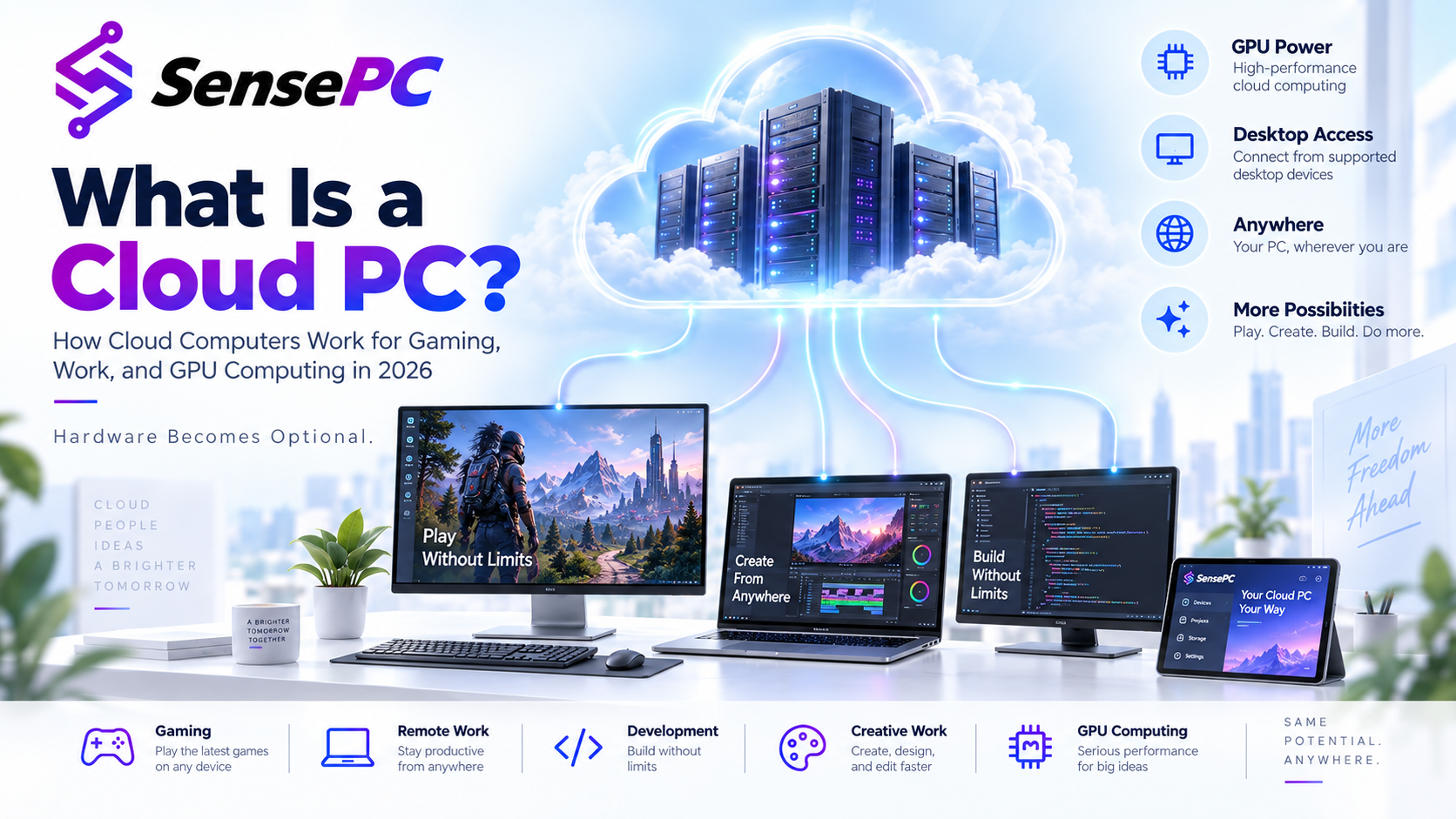
The CPU, memory, and GPU can run as cloud compute resources, while the operating system, applications, and files live on persistent cloud storage attached to that computer.
This distinction explains why stopping a cloud PC does not necessarily delete your files.
Does a cloud PC keep your files when it is turned off?
Yes, if the cloud PC uses persistent storage and the PC itself has not been deleted.
When a persistent cloud PC is stopped, its active compute resources can stop running while its storage remains attached.
That means your operating system, installed software, game files, documents, project folders, settings, and other stored data can still be available when the cloud PC starts again.
This behavior is similar to shutting down a physical computer. The processor stops doing work, but the SSD does not disappear.
The important difference is that cloud compute and cloud storage are usually billed and managed separately behind the scenes.
What actually happens when you stop a cloud PC?
Stopping a cloud PC generally means the active computing portion of the machine is no longer running.
The CPU is no longer processing your applications. GPU workloads stop. Active memory is no longer being used as a running session. Remote streaming ends because there is no active desktop to display.
Persistent storage, however, can continue to exist.
When the PC starts again, the compute resources reconnect to the stored operating system and data, allowing the machine to return with its applications and files still present.
This separation is one of the core ideas that makes cloud computing flexible.
Why can storage still cost money when the PC is stopped?
Stopping compute does not necessarily remove the infrastructure used to store your data.
If a provider continues holding hundreds of gigabytes of SSD capacity for your operating system, applications, games, project files, and personal data, that storage still consumes cloud infrastructure even though the CPU and GPU are not currently running.
That is why a cloud PC can have two different cost states:
Running: active compute plus persistent storage.
Stopped: compute is stopped, but persistent storage can continue to generate storage cost.
This distinction matters when comparing cloud PC pricing.
A service that advertises an hourly compute price may still have separate storage costs. Users should understand both parts before estimating what a cloud PC will cost over a month.
How SensePC handles storage when a PC is stopped
SensePC separates active PC usage from persistent SSD storage.
When a SensePC is stopped, the active compute portion of the PC is no longer being used, but the storage associated with the PC remains available while that PC continues to exist.
This allows installed applications and user files to persist between sessions rather than requiring the machine to be rebuilt every time it starts.
Because the storage continues to exist, SSD storage remains billable while the PC is stopped.
This is an important distinction for users who create a cloud PC for occasional use. Stopping the machine can reduce active compute usage, but it should not be treated as equivalent to deleting all cloud resources.
Stopping a cloud PC is not the same as deleting it
Stopping and deleting are fundamentally different actions.
| Action | Compute | Persistent Storage | Files |
|---|---|---|---|
| Running | Active | Attached | Available |
| Stopped | Inactive | Usually remains attached | Usually retained |
| Deleted | Removed | May be removed according to provider policy | Can be permanently lost |
A stopped PC is intended to be started again.
A deleted PC should be treated as a destructive action.
Before deleting any cloud PC, move important files somewhere else unless the provider explicitly confirms that the data will remain available.
Is cloud PC storage the same as cloud backup?
No.
Persistent storage and backup solve different problems.
Persistent storage is the working disk used by the cloud computer. It contains the operating system, applications, and files that the PC actively uses.
A backup is a separate copy of important data that can help recover information if the primary copy is accidentally deleted, corrupted, or otherwise lost.
The fact that your files survive a normal stop-and-start cycle does not mean they are automatically backed up.
Important data should always have an independent backup strategy.
What happens to installed applications?
Applications installed on persistent storage can remain installed after the cloud PC is stopped.
This is especially important for cloud gaming, development environments, creative software, and engineering applications, where downloading and configuring software can take substantial time.
If the operating-system disk remains persistent, restarting the cloud PC should not require reinstalling every application simply because compute was stopped.
The exact behavior still depends on the provider's storage architecture and lifecycle policies.
What happens to games installed on a cloud gaming PC?
Games can consume a large amount of SSD capacity, making storage an especially important part of cloud gaming.
A modern game library can quickly use hundreds of gigabytes once the operating system, launchers, individual games, downloadable content, shader caches, updates, and user files are included.
When those games are installed on persistent cloud PC storage, they can remain available between sessions even when the active PC is stopped.
This is more convenient than redownloading large games every time the system starts.
It also means gamers should consider storage capacity before creating the machine rather than looking only at GPU specifications.
How much cloud PC storage do you need?
There is no single correct storage size for every user.
The right amount depends on what will actually live on the cloud PC.
A browser-focused or light productivity environment may need relatively little beyond the operating system and applications.
Software developers may need room for source repositories, build artifacts, container images, SDKs, virtual environments, and development tools.
Creative workloads can generate large project files, media assets, caches, and exports.
Gaming is often one of the most storage-intensive use cases because several modern games can consume hundreds of gigabytes by themselves.
The best approach is to estimate the software and data you expect to keep on the PC and leave reasonable free capacity for updates and temporary files.
Why free SSD space matters
An SSD should not be planned so tightly that it is nearly full from the first day.
Operating-system updates, application updates, temporary files, browser caches, game patches, development dependencies, and application-generated data all need additional capacity over time.
Running out of storage can prevent updates, disrupt applications, or force users to spend time deleting data unexpectedly.
Planning with headroom usually creates a better experience than selecting a disk size based only on today's exact file total.
Can cloud PC storage be increased later?
Many cloud platforms support some form of storage expansion, but the exact behavior depends on the product.
Some services allow a disk to grow but do not allow it to shrink afterward. Others require a different workflow for adding additional storage.
Before creating a cloud PC, check whether the provider supports storage increases, decreases, additional volumes, and whether resizing requires the PC to be stopped.
For SensePC, users should use the currently available storage controls shown in the dashboard and verify the current supported configuration before resizing.
Should you store everything directly on the cloud PC?
Not necessarily.
A good cloud workflow often separates active working storage from files that should be portable or independently protected.
The cloud PC's SSD is useful for the operating system, installed applications, active projects, game installations, caches, and files that need fast access from the remote machine.
Important documents and long-term files may also belong in a separate cloud-storage or backup service depending on the user's needs.
This separation can make it easier to replace, resize, or delete a cloud PC without treating the machine itself as the only copy of important data.
Cloud PC storage vs cloud file storage
A cloud PC disk and a cloud file-storage service are related concepts, but they are not interchangeable.
The cloud PC disk behaves like the internal drive of a computer. Applications can install onto it, the operating system can boot from it, and programs can continuously read and write data.
Cloud file storage is usually designed primarily for storing, synchronizing, sharing, or transferring files.
A user may therefore use both.
The cloud PC disk can provide the active computing environment, while separate cloud storage provides portability or an additional location for important data.
What should you do before deleting a cloud PC?
Assume that deletion can be permanent.
Before deleting a cloud PC, review the files stored on it and move anything important to another location.
That can include documents, project folders, saved game files that are not synchronized elsewhere, exports, configuration files, credentials stored in files, locally stored development work, and media assets.
Do not rely on the ability to recover a deleted cloud disk unless the provider explicitly offers and documents that recovery mechanism.
Persistent storage makes a cloud PC feel like your computer
Without persistent storage, a remote computer would behave more like a temporary session. You could use compute resources, but the environment could disappear when the session ended.
Persistent storage changes that.
It allows the operating system, applications, settings, and files to survive between compute sessions, which is what makes a cloud PC practical as an ongoing personal computing environment.
The machine can stop without forcing the user's entire digital workspace to disappear.
Storage should be part of the cloud PC buying decision
GPU model and CPU count are easy specifications to compare, but storage deserves equal attention.
Users should understand how much capacity is included, whether storage remains persistent, whether it is billed while compute is stopped, whether it can be expanded, what happens during deletion, and how important files should be backed up.
These details directly affect both usability and long-term cost.
A cloud PC is most useful when users understand not only how to start it, but also what continues to exist after they stop it.
The simple rule
Stopping a cloud PC should not be confused with deleting its storage.
With persistent storage, compute can stop while the disk remains available for the next session.
That persistence is what lets a cloud PC behave like a computer you can return to instead of a disposable remote session.
For SensePC users, the practical rule is straightforward: stop the PC when you are finished using active compute, but remember that persistent SSD storage remains associated with the PC and can continue to generate storage cost while the PC exists.
Understanding that distinction makes it easier to manage both your data and your cloud PC budget.